


The international conference “Transitioning Away from Fossil Fuels“, held in Santa Marta (Colombia) between 24 and 29 April, represents a crucial moment in global climate diplomacy. Born as a development of the path initiated after COP30 and coordinated by the governments of Colombia and the Netherlands, it brought together over 50 governments alongside a broad coalition of actors including indigenous communities, social movements, NGOs, academics, and institutions. The main objective of the meeting was to accelerate the global transition beyond fossil fuels, addressing the climate crisis through a more inclusive, just and territorially grounded approach.
Several members of the Jean Monnet Centre of Excellence on Just Fossil Fuel Transitions and of the research group “Climate Change, Territories and Diversity” of the University of Padova took part in the conference in the chapters dedicated to the academic world and civil society, contributing through the sharing of scientific research on the geovisualisation of territories in transition away from fossil fuels, the co-organisation of some of the work streams and the coordination of side events held alongside the conference.
Purpose and Structure of the Conference
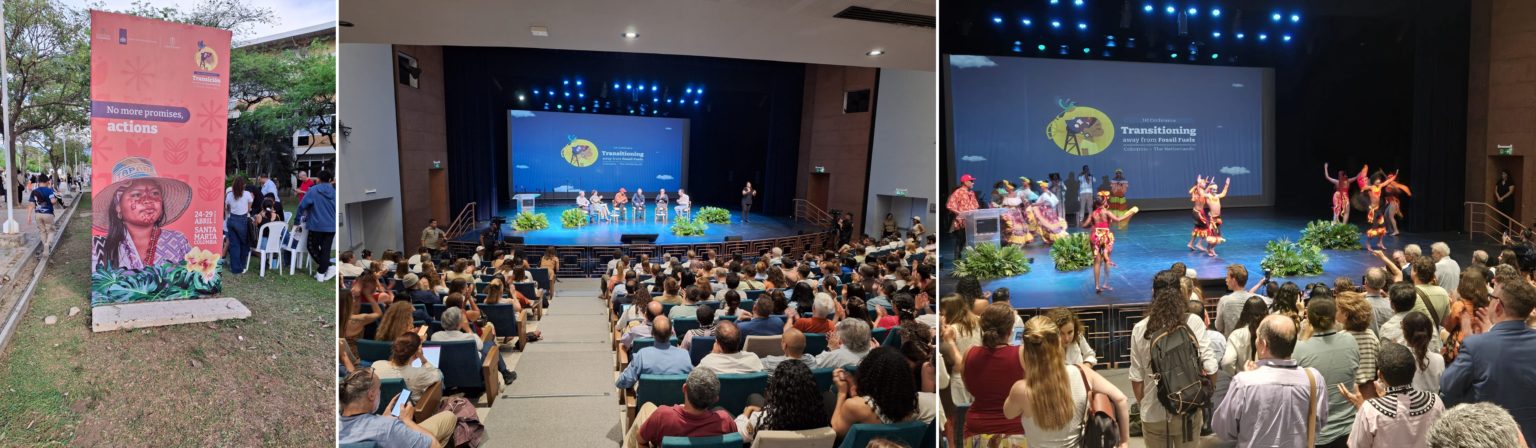
The conference was characterised by a tripartite structure: an academic component, a civil society component and a governmental one. The academic part, organised as a scientific pre-conference, provided analyses, models and policy proposals on the energy transition, including several work streams on topics such as exiting extractivism and phase-out policies.
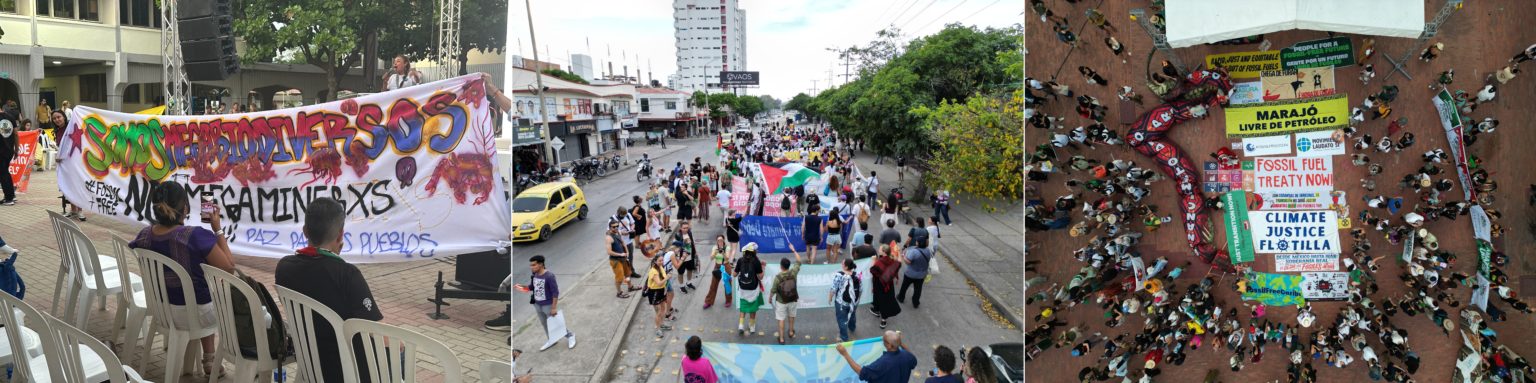
In parallel, civil society gathered at the “People’s Summit for a Fossil Free Future”, an autonomous and participatory space aimed at building a bottom-up vision of the transition. Finally, the governmental dimension hosted the high-level political segment, in which States discussed and defined concrete outcomes and future commitments.
This articulation aimed to bridge the gap between scientific knowledge, social mobilisation and political decision-making, creating a convergence process among actors who are often kept separate. However, a significant tension also emerged: civil society participation in governmental decision-making processes remained limited, with the risk of a growing distance between political declarations and the demands of local territories.
The Scientific Pre-Conference
The academic pre-conference informed the Pre-conference Synthesis Report (SMART), a document gathering research community recommendations for governments. During the discussions, numerous critical observations emerged aimed at overcoming the techno-optimistic framing of the document’s draft, highlighting in particular the need to better acknowledge the role of civil society in the transition away from fossil fuels and the power imbalances between territorial communities and fossil capital.
The coordinators also stressed the importance of consolidating the international network built during the conference, encouraging the formation of “coalitions of the willing” aimed at producing scientific articles and peer-reviewed reports capable of sustaining the political and public debate on the energy transition.
From the final summaries of the working groups in which the research team participated, several particularly relevant critical lines emerged:
- transforming power relations in the energy transition, avoiding the creation of new “sacrifice zones” and eliminating those already in existence;
- decentralising planning processes, while at the same time strengthening international frameworks capable of connecting diverse actors, supporting co-creation, and accelerating collective learning;
- broadening knowledge production processes by including epistemologies from the Global South and anti-colonial approaches, moving beyond exclusively technical and academic models in favour of territorially grounded perspectives.
Fossil Fuel-Free Territories
One of the most significant focal points of the conference was the “Conference on Fossil Fuel-Free Territories”, which brought together indigenous communities and territorial movements engaged in resistance to extractivism, particularly from the Amazon region. Here, a radical vision of transition emerged: not simply a technological shift, but a profound transformation of the relationships between society, economy, and nature.
The political and operational declaration on fossil fuel-free territories underlines that the transition must be grounded in territorial sovereignty, social justice and respect for ecosystems. In this sense, freeing territories from fossil fuels implies guaranteeing autonomy over energy, water and food, without which no real alternative can exist.
A central element is the critique of the current “just transition” model, often perceived as a reorganisation of extractivism under new “green” forms. Participants denounced the risk of new “sacrifice zones” linked to renewable technologies and critical raw materials, calling instead for systemic change based on democracy and local knowledge.
The declaration also insists on the link between fossil fuel-free territories and “territories of peace”: the end of extractivism is seen as a condition for reducing conflicts, violence and inequalities. Among the proposals that emerged are the strengthening of environmental institutions, the recognition of community rights and the creation of participatory territorial planning tools.
The Civil Society Declaration
The People’s Summit produced one of the most impactful documents of the entire conference: the “People’s Declaration for a Rapid, Equitable and Just Transition for a Fossil-Free Future”. This text represents a synthesis of the demands of global movements and local communities, the result of a participatory process lasting several months.
The declaration interprets the climate crisis as the result of a global system founded on capitalism, colonialism, and militarism. Consequently, the energy transition cannot be limited to the replacement of energy sources, but must transform global economic and political structures.
Among the main demands:
- an immediate halt to new coal, oil, and gas projects;
- a rapid phase-out of existing fossil fuel infrastructure;
- the rejection of “false solutions” such as carbon capture, offsets, and geoengineering;
- the cancellation of debt for countries of the Global South;
- non-debt-based public financing and climate reparations.
The declaration also underlines the need to place human rights and the rights of nature at the centre of the transition, promoting energy democracy and direct community participation.
The Final March and Mobilisation
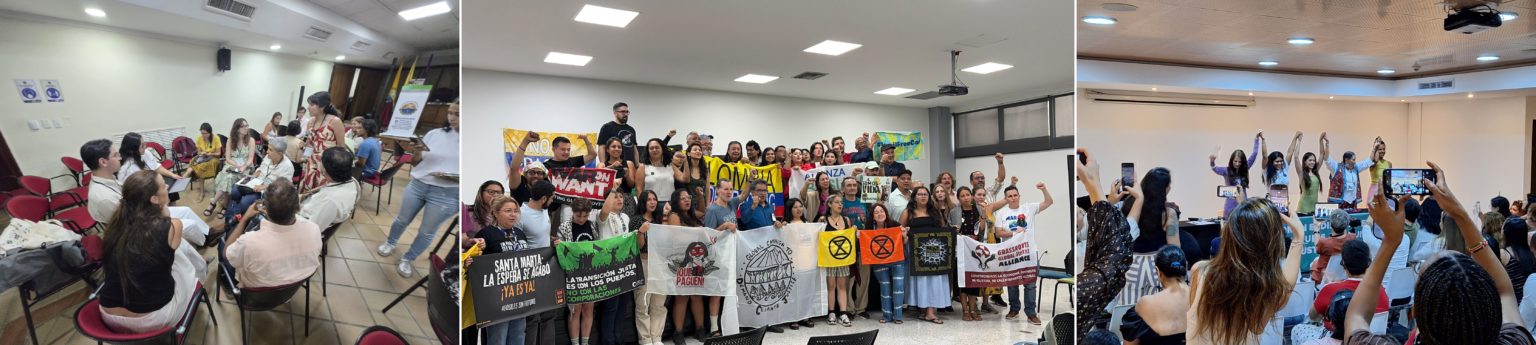
A moment of great symbolic and political significance was the final mobilisation. Over 2,000 people took part in the “March for a Fossil Free Future”, moving through the streets of Santa Marta with music, dance, and artistic performances.
The march represented the shift from discussion to action: the demands that had emerged in the preceding days were brought into the public space, transforming the city into a place of collective expression. This moment also strengthened the link between the People’s Summit and the institutional process of the Assembly of the People, where civil society proposals were formally presented to the Colombian government.
Alongside the march, direct actions such as the blockade of the Drummond coal port highlighted the will to strike symbolically and concretely at fossil fuel infrastructure, denouncing its socio-environmental impacts.
Outcomes of the Governmental Segment
The governmental segment produced some concrete outcomes, though not without limitations. The main results include:
Creation of the Science Panel for the Global Energy Transition (SPGET): a global scientific platform to support governments in reducing dependence on fossil fuels and maintaining the 1.5°C target.
Definition of three main work trajectories:
- development of national phase-out roadmaps;
- reform of financial architectures (debt, subsidies, taxation);
- transformation of trade systems towards a decarbonised economy.
Significant political announcements:
- Colombia declared the goal of reducing fossil fuel demand by 90% by 2050;
- France became the first nation to present a detailed fossil fuel exit plan (coal by 2027, oil by 2045, gas by 2050).
Launch of a new international process: a second conference in 2027 in Tuvalu was announced, co-organised by the Republic of Ireland, with the intention of bringing the debate to the territories most vulnerable to the climate crisis.
Acknowledgement of the limits of current climate governance: several governments admitted the failure of existing multilateral mechanisms, often influenced by fossil fuel interests, proposing the creation of new global instruments, such as a fossil fuel non-proliferation treaty.
In parallel, dialogue with trade unions highlighted the need to guarantee decent work, public services and energy democracy, while Colombian ministries stressed the urgency of bringing forward the abandonment of fossil fuels for both climate and geopolitical reasons.
Between the Amazon and the Arctic: Pathways for Just and Territorially Grounded Fossil Fuel Transition. Forum on the Geovisualisation of the Social Dynamics of Yasunisation – Side Event of 29 April
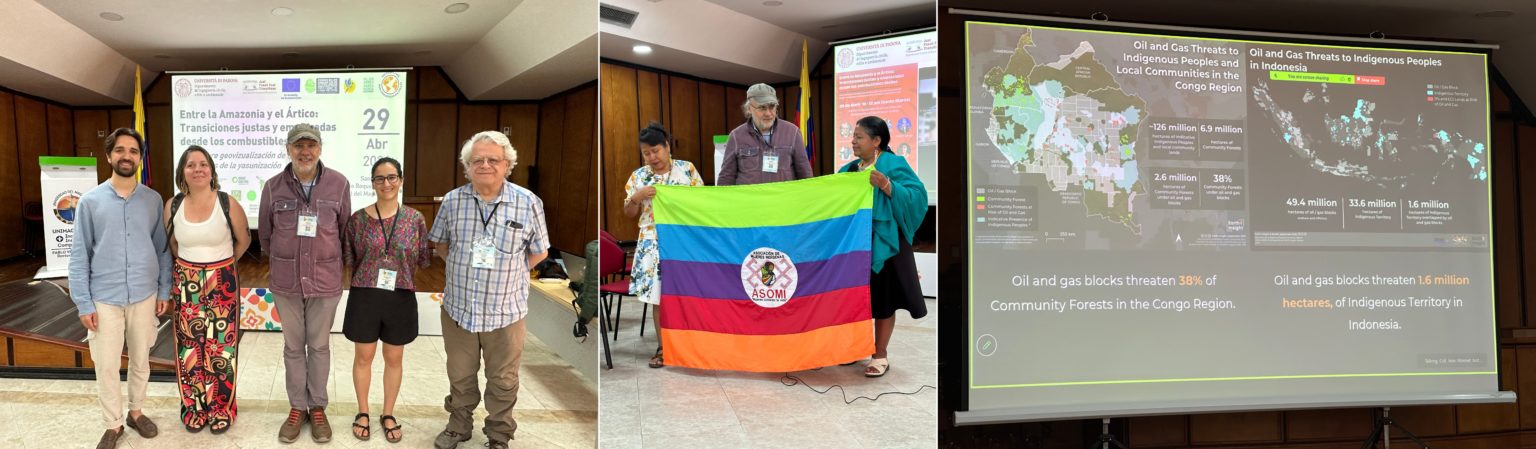
Adopting a territory-based perspective and taking the iconic regions of the Arctic and the Amazon rainforest as reference points, the Jean Monnet Centre of Excellence on Just Fossil Fuel Transitions coordinated the side event of 29 April at the Universidad del Magdalena.
The forum discussed the urgency of a just energy transition, analysing the gradual phase-out of fossil fuels from a localised perspective and comparing the practices of territorial communities with the actions of extractive capitalism. Geovisualisation served as the common thread for framing where situations occur, the scale of the pressures involved, the imagining of alternatives, and the process of implementing transformative transitions. The forum also contributed feedback to the ongoing preparation of the “Atlas for a Just Transition from Fossil Fuels” and the “Dictionary of Climate Justice Practices for the Transition from Fossil Fuels”.
Thirteen organisations collaborated in the preparation, communication, and implementation of the forum, offering a panel of researchers and activists: Jean Monnet Centre of Excellence on Just Fossil Fuel Transitions (coord.), Acción Ecológica, Unión de Afectados y Afectadas por las Operaciones Petroleras de Texaco (UDAPT), Colectivo de Geografía Crítica, Fundación Pachamama, Universidad Andina Simón Bolívar, CENSAT Agua Viva, Pacto Ecosocial y Intercultural del Sur, Red para la Reducción de Combustibles Fósiles en América Latina y el Caribe, University of Sussex, Earth Insight, Sovereign Inupiat for a Living Arctic (SILA), Universidad del Magdalena.
Taking the Amazon and the Arctic as iconic regions of transformation, the dialogue transcended the local to explore yasunisation as a global phenomenon of social mobilisation generated by a multitude of grassroots initiatives. The focus was on already existing territorial practices in order to identify operational pathways following the five days of discussions and reflections across various sectors and contexts of the Santa Marta Conference.
The voices of the territories, conveyed through witnesses, maps, and images, were at the heart of the forum. Siqiñiq Maupin shared the perspectives of Iñupiaq communities on the fossil fuel transition in the Arctic, comparing the map of Alaska with that of the United States and locating transnational Inuit territories beyond US borders.
Esperanza Martínez focused on reparative climate justice in the phase of decommissioning and restoration of the Yasuní ITT project in Ecuador, stressing the importance of training and exchange with other experiences. Javier Felix presented alternative territorial management in the Ecuadorian and Peruvian Amazon (Cuencas sagradas) based on bioregional planning.
Carlos Larrea envisioned scenarios for implementing the Yasuní initiative in regions with greater biodiversity in developing countries.
Massimo De Marchi presented a series of applied research studies on the permanence of fossil fuels in the subsoil in various parts of the world, focusing on the Arctic, the Amazon, and Italy, underlining the importance of an extreme citizen science approach combining field mapping with drone surveys, satellite imagery, and GIS analysis.
María José Guichay Álvarez shared experiences of energy communities in Latin America, highlighting how hope resides in practices already existing within territorial autonomies.
Liliana Buitrago illustrated the role of the ecosocial and intercultural pact of the Global South for a just transition based on the valorisation of diversities.
Ignacio Arroniz Velasco presented maps highlighting the threats and challenges of fossil fuel extractivism in territories across Africa and South-East Asia.
The debate space among participants was rich and highly interactive, and concluded with the intervention of representatives of ASOMI (the association of indigenous women of Putumayo), who shared their territorial concern over the risk of an extractive transition from oil to copper. They closed their intervention with a song shared with all participants.
To learn in detail about the events, discussions and topics addressed day by day during the conference, we invite you to read the daily reports published by the Centre of Excellence within the newsletter
The Climate Corner